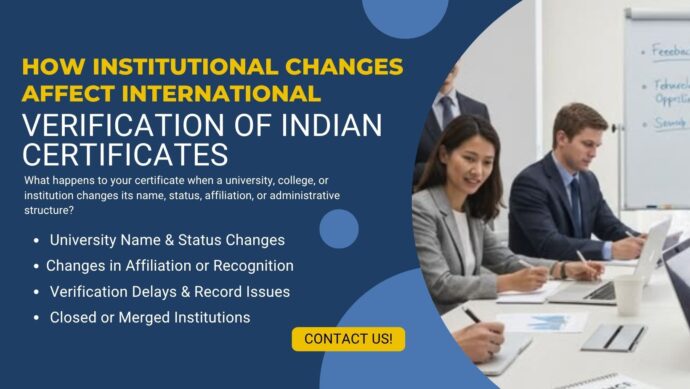
How Institutional Changes Can Affect the International Verification of Indian Certificates
When an Indian certificate is submitted for use in another country, the process is not limited to obtaining a stamp or attaching an apostille. International acceptance often depends on a chain of verification involving educational institutions, government authorities, foreign missions, and overseas organisations. When any institution changes its procedures, documentation standards, verification methods, or administrative structure, the way certificates are processed can also change.
Understanding these institutional changes is important for students, professionals, families, and businesses preparing documents for international use. Proper planning can reduce delays and help applicants avoid submitting documents that no longer meet the required verification standards.
Why Institutional Verification Matters
A certificate issued in India may need to be verified before an overseas university, employer, immigration authority, or government department accepts it. The purpose of verification is generally to establish that the document is genuine and was issued by an authorised institution.
Universities and other issuing authorities may update their verification systems over time. For example, an institution may move from physical verification to an online request system or introduce additional procedures for confirming records. Such changes can affect the documentation required before further legalisation or authentication.
For applicants arranging Certificate Apostille in Delhi, understanding the current verification requirements of the issuing institution can therefore be an important part of document preparation.
How Universities and Institutions Can Change the Process
Educational institutions do not always follow the same verification procedure. Some may verify certificates directly, while others may require applications through designated departments, online portals, authorised representatives, or specific document formats.
Changes in administration can also influence how verification requests are handled. A university may introduce a new digital database, modify its verification office, change authorised signatories, or update the format used for confirming academic records.
These developments can create practical differences for applicants. A procedure that worked for an older certificate may not necessarily apply to a recently issued document. This is why checking the latest requirements before starting the process is essential.
The Impact of Digital Verification
Digital transformation is one of the most significant institutional changes affecting international document processing. Many Indian institutions are gradually adopting online databases, digital records, electronic verification requests, and secure document systems.
Digital verification can make the process more convenient, but it can also introduce new requirements. Authorities may need specific registration numbers, online verification links, QR codes, digital signatures, or database references to confirm the authenticity of a document.
For someone seeking Certificate Apostille in Delhi, the availability of reliable institutional records can influence how smoothly the document moves through the authentication process.
Changes in Government Procedures
Institutional changes are not limited to universities. Government departments involved in document authentication may also update their procedures, submission requirements, appointment systems, or accepted document formats.
Such changes can affect the sequence in which documents should be prepared. A certificate may need verification at one stage before it can proceed to another authority. If an applicant follows an outdated process, the document may be returned for correction or additional verification.
This is particularly important when documents are being prepared for countries with specific legalisation requirements. Applicants should confirm the current procedure rather than relying entirely on older experiences or information found in outdated sources.
Why Document Accuracy Becomes More Important
Institutional changes can make small discrepancies more noticeable. Differences in names, dates, certificate numbers, signatures, seals, or institutional details may create questions during verification.
Before submitting a document, applicants should carefully compare the certificate with their supporting records. If an issuing institution has changed its certificate format or verification method, older documents may also require additional confirmation.
Professional guidance from Talent Overseas can help applicants understand the documentation pathway and identify potential issues before submission.
International Acceptance Is More Than Authentication
One important point is that authentication confirms the origin or legitimacy of a document; it does not automatically guarantee that every foreign organisation will accept the contents of that document.
An overseas university, employer, licensing body, or government authority may have its own eligibility requirements. For example, an employer may require a particular qualification, while a university may separately assess academic equivalency. Therefore, applicants should treat authentication and international acceptance as related but separate stages.
How Applicants Can Prepare for Institutional Changes
A few practical steps can make international document preparation more organised:
- Check the latest verification requirements of the issuing institution.
- Confirm whether online or physical verification is required.
- Review names, certificate numbers, dates, and other details carefully.
- Keep original certificates and supporting records available.
- Confirm the destination country’s current legalisation requirements.
- Avoid depending solely on older procedures followed by friends or relatives.
- Seek professional assistance when the verification chain is unclear.
These steps can be especially useful when preparing documents through Certificate Apostille in Delhi, where the correct sequence of verification and authentication can help prevent avoidable delays.
Conclusion
Institutional procedures are not permanent. Universities, government departments, authentication authorities, and foreign missions may introduce new systems or modify existing requirements as documentation becomes increasingly digital and internationally connected.
For anyone planning to use an Indian certificate abroad, staying informed about these changes is essential. Proper verification, accurate documentation, and awareness of destination-country requirements can make the overall process more efficient.
With professional support from Talent Overseas, applicants can approach international document processing with a clearer understanding of the verification and authentication stages. Rather than treating apostille or legalisation as a simple formality, it is better to view the process as a structured chain in which every institutional requirement can influence the final acceptance of an Indian certificate abroad.