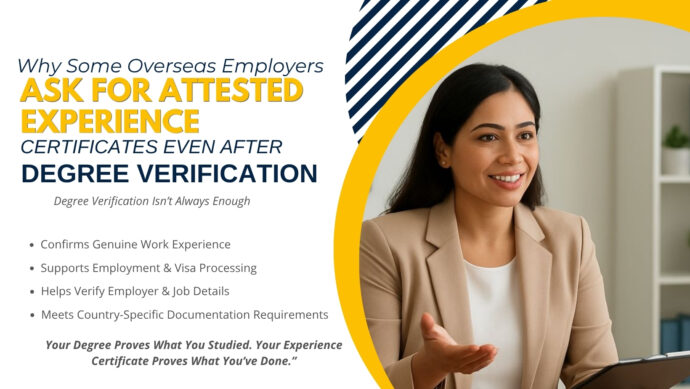
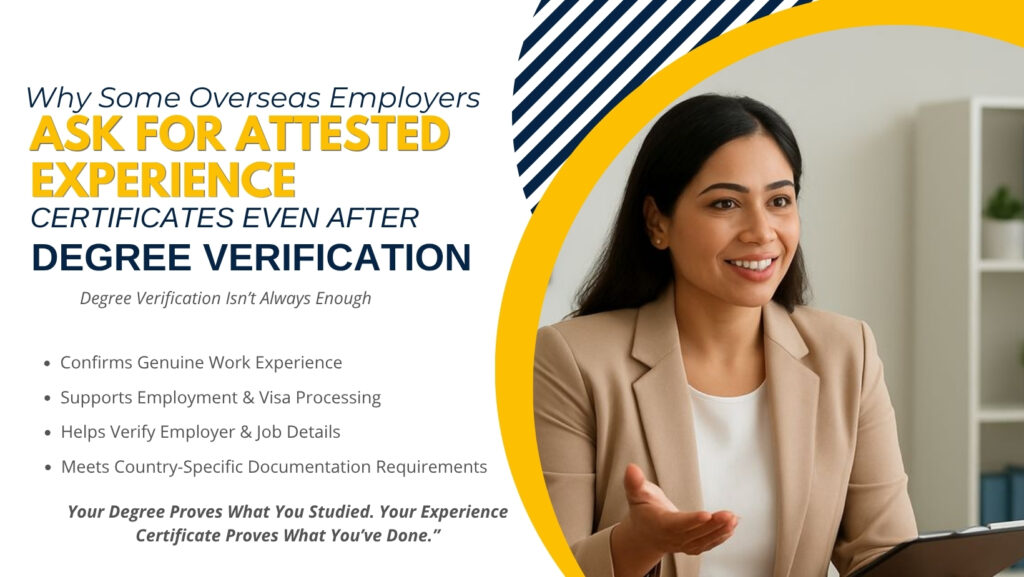
Why Some Overseas Employers Ask for Attested Experience Certificates Even After Degree Verification
When applying for an overseas job, many professionals assume that verifying their educational qualifications is enough to establish their credibility. However, some international employers may also request an attested experience certificate, even when the applicant’s degree has already been successfully verified. This may seem unnecessary, but there is an important reason behind the distinction.
A degree confirms your educational background, while an experience certificate helps an employer establish your professional history. Understanding why both documents may require verification can help applicants avoid delays during international employment processes.
Degree Verification and Experience Verification Are Different
Degree verification primarily establishes whether an academic qualification was genuinely issued by the stated university or educational institution. It confirms details such as the qualification, institution, and sometimes the period of study.
An experience certificate serves a different purpose. It generally provides information about your previous employment, including your job title, duration of employment, organisation, and responsibilities. Therefore, verifying a degree does not automatically verify your professional experience.
For employers recruiting internationally, both academic and employment credentials can be important when assessing whether an applicant meets the requirements of a position.
Why Do Overseas Employers Request Attested Experience Certificates?
1. To Confirm Previous Employment
An overseas employer may want independent confirmation that an applicant actually worked for the organisation mentioned on their résumé. An attested certificate can provide an additional layer of document authentication.
This becomes particularly relevant for positions where previous professional experience is a mandatory requirement. Employers may need confidence that the claimed experience is supported by an authentic document.
2. Different Authorities Verify Different Information
Educational qualifications and employment records are usually connected to different issuing bodies. A university can verify an academic certificate, while an employer or relevant authority may be responsible for confirming professional experience.
Because these are separate records, successful degree verification does not necessarily establish the authenticity of an experience certificate.
Applicants working with a Certificate Attestation Agent In Delhi may therefore be advised to process their employment documents separately, depending on the requirements of the destination country or employer.
3. Immigration and Employment Compliance
In some countries, professional experience can play a role in work permit, visa, licensing, or employment eligibility procedures. Employers may therefore request authenticated employment documents to support their recruitment or compliance process.
The exact requirements can differ depending on the destination country, profession, employer, and purpose for which the document is being submitted. Applicants should always confirm which authentication procedure is actually required before beginning the process.
Experience Certificates Can Contain Important Details
An experience certificate may contain information that cannot be established through a degree verification process. For example, it can show the employee’s designation, employment period, organisation name, and other relevant employment details.
If these details are important to the overseas position, the employer may want them independently authenticated. This is one reason applicants should not assume that completing academic verification eliminates the need for employment-document attestation.
What Happens If an Experience Certificate Cannot Be Verified?
Verification can sometimes become complicated when an organisation has changed its name, merged with another company, closed its operations, or no longer maintains easily accessible employment records.
Differences in names, dates, job titles, signatures, stamps, or company information can also create questions during document processing. Preparing the correct supporting documents in advance can help reduce unnecessary complications.
Professionals seeking assistance in western India may consult a Certificate Attestation Agent In Mumbai to understand the document requirements applicable to their intended destination and employment purpose.
Why Professional Guidance Can Be Useful
Certificate authentication involves more than simply obtaining a stamp on a document. The correct process may depend on where the document was issued, where it will be used, and what the receiving authority requires.
A professional service provider can help applicants understand the sequence of verification, attestation, apostille, or embassy-related procedures where applicable. This can be especially useful when multiple documents need to be processed at the same time.
Applicants based in southern India can also consult a Certificate Attestation Agent In Chennai when they need assistance determining the appropriate process for employment documents.
How Applicants Can Avoid Delays
Before submitting an experience certificate to an overseas employer, applicants should carefully check the following:
- Ensure the employee name matches other submitted documents.
- Check employment dates and designation for accuracy.
- Confirm that the certificate has been issued by the appropriate authority.
- Ask the employer whether attestation, apostille, or another form of authentication is required.
- Keep supporting employment records available if additional verification is requested.
- Avoid assuming that degree verification automatically covers employment documents.
Conclusion
Degree verification and experience certificate attestation serve different purposes. While academic verification establishes your educational credentials, an attested experience certificate can help an overseas employer establish the authenticity of your professional history.
For applicants preparing documents for international employment, understanding these differences can prevent confusion and unexpected delays. Talent Overseas assists applicants with document-related requirements and helps them understand the appropriate authentication process based on their individual circumstances and destination requirements.
When every document is prepared according to the receiving authority’s requirements, the overseas employment documentation process can become more organised, transparent, and manageable.