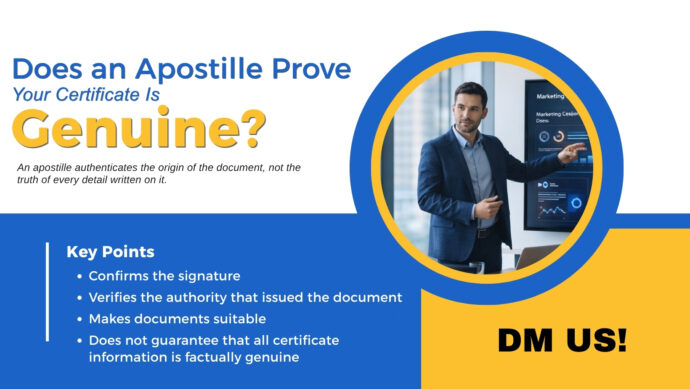
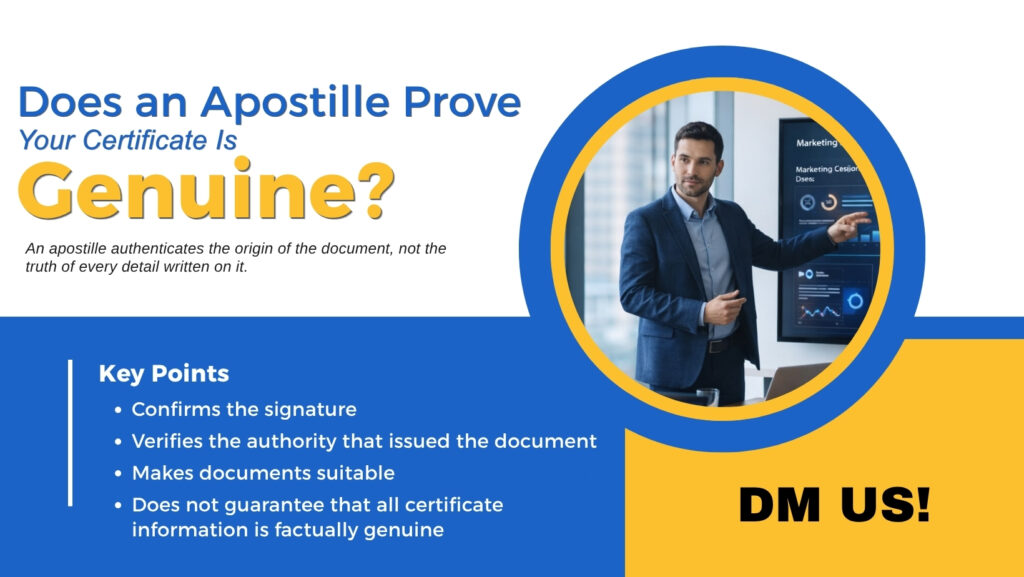
Does an Apostille Prove That the Information on Your Certificate Is Genuine?
When preparing documents for international use, many people assume that an apostille is a complete verification of everything written on a certificate. However, an apostille has a specific purpose, and understanding its role can help applicants prepare their documents correctly and avoid confusion during international document submission.
An apostille is generally used to authenticate the origin of a public document so that it can be accepted in another country that is part of the Hague Apostille Convention. It confirms the authenticity of the signature, the capacity in which the person signing the document acted, and, where applicable, the identity of the seal or stamp on the document. It does not normally certify that every piece of information mentioned in the certificate is factually true.
What Does an Apostille Actually Authenticate?
The primary purpose of an apostille is to establish the authenticity of a public document for use abroad. It creates a standardized authentication process between participating countries.
For example, if an educational certificate is issued by a recognized authority in India and needs to be submitted overseas, the apostille process helps the receiving authorities identify that the document comes from the appropriate official source. The apostille relates mainly to the origin and formal authenticity of the document, rather than independently investigating all the information contained within it.
This distinction is important because applicants may otherwise expect an apostille to function as a complete background verification of their qualifications, personal details, employment history, or other information.
Does an Apostille Verify the Contents of a Certificate?
Generally, no. An apostille does not mean that the authority issuing the apostille has independently verified every statement appearing on the underlying document.
Consider a degree certificate. The apostille can authenticate the relevant signature, seal, or official capacity associated with the document. It does not necessarily mean that the apostilling authority has investigated the student’s entire academic history or independently confirmed every academic detail printed on the certificate.
The responsibility for the accuracy of the information generally remains with the issuing authority and the document holder. This is why the distinction between document authentication and content verification is so important when preparing documents for international use.
Why Is This Difference Important for Applicants?
International organizations, universities, employers, immigration authorities, and government departments may have their own requirements for accepting documents. An apostilled document can establish that the document has gone through the required authentication process. However, the receiving organization may still examine the contents or request additional evidence.
For instance, an overseas university may accept an apostilled educational certificate while separately checking academic records, transcripts, accreditation, or other supporting documents.
Similarly, an employer may request additional proof of qualifications even when the certificate has been apostilled. Therefore, applicants should always check whether their destination authority requires apostille alone or additional verification and supporting documents.
Apostille and Certificate Authenticity: What Should You Check?
Before submitting a document for apostille, applicants should carefully review the certificate itself. Important details may include:
- Name of the document holder
- Certificate number or registration details
- Date of issue
- Name of the issuing institution or authority
- Official signatures and seals
- Spelling of personal information
- Supporting documents, where required
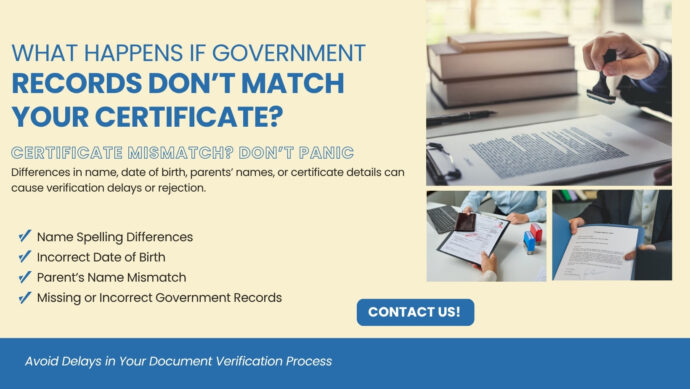
If any information needs correction, it is generally better to resolve the issue with the issuing authority before beginning the authentication process. Obtaining an apostille does not usually correct errors contained in the original certificate.
Does the Process Differ by City?
The basic concept of apostille authentication remains the same, but applicants may begin their document preparation from different cities depending on where they live or where their documents are being processed.
For individuals looking for Certificate Apostille in Delhi, it is useful to understand the document requirements before submitting certificates for authentication. Proper preparation can make the process more organized and efficient.
Applicants seeking Certificate Apostille in Mumbai should similarly check whether their particular document requires any preliminary authentication or supporting verification before apostille processing.
Those arranging Certificate Apostille in Chennai can also benefit from confirming the requirements associated with their certificate type and intended destination country before proceeding.
What an Apostille Does Not Guarantee
An apostille should not automatically be interpreted as a guarantee that:
- Every statement in the certificate is factually accurate.
- The qualification has been independently evaluated by the destination country.
- The receiving organization must accept the document for every purpose.
- The certificate meets every immigration, employment, education, or legal requirement.
- Additional verification will never be requested.
The receiving authority ultimately determines whether the document satisfies its specific requirements.
How to Prepare Your Certificate for International Use
A smooth document authentication process starts with understanding the destination country’s requirements. First, identify whether the destination country is a participant in the Hague Apostille Convention and determine whether an apostille is the appropriate authentication route.
Next, verify that your original certificate is complete and contains accurate information. If preliminary authentication is required for your document category, complete that step before proceeding with the apostille. Finally, check the requirements of the organization receiving your document. Some authorities may require certified translations, additional supporting documents, or other formalities alongside the apostille.
Final Thoughts
An apostille is an important form of international document authentication, but it should not be confused with a comprehensive verification of the information contained in a certificate. Its core function is to authenticate the document’s official origin, signature, seal, or related authority so that the document can be presented internationally under the applicable system.
Understanding this distinction allows applicants to prepare their documents more accurately and determine whether additional verification is necessary. Before beginning the process, always consider both the type of certificate and the requirements of the destination authority.