How Digital Verification Is Changing Traditional Document Attestation in India
International education, employment, business expansion, and migration often require Indian documents to be accepted by authorities in another country. Traditionally, this involved multiple physical checks, stamps, signatures, and visits to different offices. However, digital verification is gradually changing how document authenticity is established and how attestation-related processes are managed.
The shift does not simply mean replacing paper with digital files. It represents a broader move toward faster verification, better traceability, and easier access to document information. For applicants, understanding this transition can help them prepare documents more accurately and avoid unnecessary delays.
What Is Digital Document Verification?
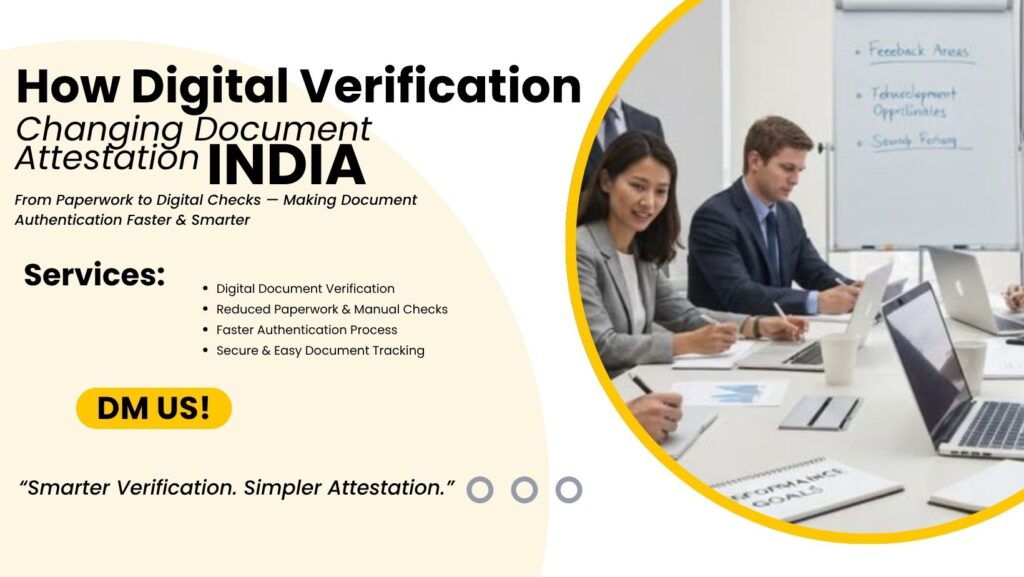
Digital verification is the process of confirming whether information contained in a document is genuine by using electronic records, databases, secure links, QR codes, digital signatures, or other verification technologies.
For example, an educational certificate may be checked against records maintained by an educational institution or authorized database. Instead of depending entirely on a physical stamp, the receiving authority can potentially verify the document’s origin and validity through a digital system.
However, digital verification and attestation are not always the same thing. Depending on the destination country and purpose of the document, applicants may still need specific authentication, legalization, apostille, or embassy-related procedures.
Why Is India Moving Toward Digital Verification?
The traditional document process can involve several stages, particularly when documents are being prepared for international use. Physical handling also creates practical challenges such as transportation, document loss, duplicate submissions, and difficulty tracking the status of verification.
Digital systems can address some of these issues by making information easier to validate and records easier to trace.
Some important advantages include:
- Faster access to records: Authorized institutions can verify information electronically.
- Improved authenticity checks: Digital records can help identify inconsistencies or altered documents.
- Better traceability: Electronic verification creates a clearer record of where and when information was checked.
- Reduced dependence on physical paperwork: Certain stages may become more convenient as digital infrastructure develops.
- Greater convenience for applicants: People preparing documents from different cities can manage parts of the process without repeated physical visits.
How Digital Verification Is Affecting Attestation Services
The growing use of technology is also influencing professional document service providers. Instead of focusing only on physical document submission, modern service providers increasingly need to understand verification requirements, institutional records, document formats, and digital authentication systems.
For individuals searching for Document Attestation in Delhi, this development means the preparation stage is becoming increasingly important. A certificate with incorrect information, mismatched names, unclear records, or incomplete supporting documents can create problems even before the attestation stage begins.
Similarly, applicants seeking Document Attestation in Mumbai may benefit from checking whether their documents can be properly verified by the issuing institution before beginning an international documentation process.
This is particularly relevant for educational certificates, personal documents, commercial papers, and other records that may need to pass through different levels of authentication depending on their intended use.
Digital Verification Does Not Make Attestation Unnecessary
One common misconception is that digital verification will completely eliminate traditional attestation. In reality, the two processes can serve different purposes.
Verification generally confirms that a document or its information is genuine. Attestation or legalization, on the other hand, may provide the formal authentication required by a particular authority or foreign government.
Therefore, applicants should not assume that having a digitally verifiable certificate automatically makes it ready for international submission. The exact requirements depend on the document type, destination country, and purpose.
What Applicants Should Check Before Starting
Before beginning an international document process, applicants should pay attention to more than just stamps and signatures. They should verify that:
- Names and personal details are consistent across documents.
- The issuing institution’s records are accurate.
- Certificates are complete and readable.
- Supporting documents are available where required.
- The destination country’s requirements are understood in advance.
- Digital verification options are considered where applicable.
For people looking for Document Attestation in Chennai, this preparation can be especially useful when documents are being submitted for employment, higher education, migration, or other international purposes.
The Role of Talent Overseas in a Changing Documentation Landscape
As document processing becomes increasingly technology-driven, professional guidance remains valuable. Talent Overseas helps applicants understand documentation requirements and organize their attestation-related processes according to their intended international use.
The future is likely to combine physical authentication with digital verification rather than completely replace one with the other. Applicants may increasingly encounter documents supported by QR-based verification, digital records, electronic signatures, and secure databases alongside conventional authentication requirements.
Conclusion
Digital verification is changing the traditional approach to document attestation in India by making authenticity checks more technology-driven, traceable, and accessible. Nevertheless, digital verification does not automatically replace attestation, apostille, or legalization requirements.
For anyone preparing Indian documents for international use, the most important step is to understand the specific requirements before submission. With technology becoming a larger part of document verification, accurate preparation and professional guidance can make the overall process more efficient and reliable.