Why Some Countries Accept Apostille While Others Require Embassy Legalization
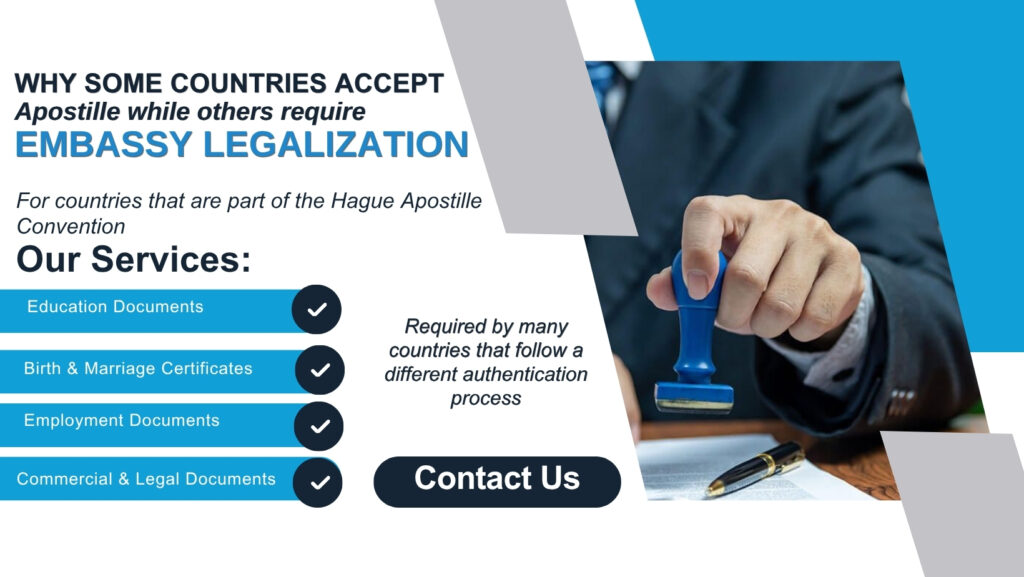
When people plan to work, study, settle, marry, or start a business abroad, document authentication is often an important part of the process. However, one common question is: Why do some countries accept an apostille while others require embassy legalization?
The answer mainly depends on the international agreements followed by the destination country. Apostille and embassy legalization are both methods of authenticating documents, but they are used under different legal frameworks. Understanding the difference can help applicants choose the correct process and avoid unnecessary delays.
What Is an Apostille?
An apostille is a form of authentication used between countries that recognize the Hague Apostille Convention. It confirms the authenticity of the signature, seal, or stamp appearing on a public document.
For example, an Indian educational certificate may need authentication before it can be submitted to an authority in another country. If the destination country accepts apostilles under the applicable international framework, an apostille can generally replace the traditional legalization process.
The apostille itself does not confirm whether the information contained in the document is true. Instead, it authenticates the official signature or seal attached to the document.
Why Do Some Countries Require Embassy Legalization?
Not every country follows the Hague Apostille Convention. When the destination country is outside this framework, documents may need to go through embassy or consular legalization.
This process usually involves authentication through the relevant authorities in the document’s country of origin, followed by verification or legalization by the embassy or consulate representing the destination country.
The additional step exists because the destination country has its own system for recognizing foreign documents. Therefore, applicants should not assume that an apostille will automatically be accepted everywhere.
Apostille vs. Embassy Legalization: The Key Difference
The biggest difference is the international system under which the document is being authenticated.
Apostille:
- Generally used between participating countries under the Hague Apostille Convention.
- Provides a standardized authentication certificate.
- Can simplify the document legalization process.
- Is commonly used for education, employment, marriage, birth, and other official documents, depending on the destination country’s requirements.
Embassy Legalization:
- Used when the destination country does not accept apostilles or requires a separate legalization procedure.
- May involve multiple authentication stages.
- Usually requires verification by the concerned embassy or consulate.
- Requirements can vary depending on the document type and destination country.
Because procedures can differ, checking the current requirements of the receiving authority is essential before submitting documents.
Does the Type of Document Matter?
Yes. The required procedure can depend not only on the destination country but also on the type and purpose of the document.
Educational certificates, marriage certificates, birth certificates, commercial documents, powers of attorney, and other public documents may have different authentication requirements. Some documents may also require state-level verification or other preliminary authentication before apostille or embassy legalization.
This is why professional guidance can be valuable. A reliable Certificate Attestation Agent In Delhi can help applicants understand which authentication route applies to their documents and intended destination.
Why Professional Assistance Can Make the Process Easier
Document authentication involves several authorities, document checks, and procedural requirements. A small difference in the destination country’s rules can determine whether an apostille or embassy legalization is required.
Applicants seeking services through a Certificate Attestation Agent In Mumbai can receive assistance with document preparation, authentication stages, and submission requirements. Professional support can also help applicants identify missing documents or procedural requirements before starting the process.
Similarly, those applying from South India can consult a Certificate Attestation Agent In Chennai for guidance on the appropriate authentication procedure based on their destination and document category.
How to Know Which Process You Need
Before starting the authentication process, consider these factors:
- Destination country: Check whether the country recognizes apostilles.
- Document type: Educational, personal, and commercial documents can have different requirements.
- Purpose of use: Employment, higher education, immigration, business, and family-related applications may involve different procedures.
- Receiving authority: The organization requesting your document may specify its authentication requirements.
- Validity and format: Some authorities may require recently issued documents, certified copies, translations, or additional verification.
Getting these details confirmed in advance can save considerable time and help ensure that your documents are prepared correctly.
Choose the Right Authentication Process with Talent Attestation
Understanding whether your destination country requires an apostille or embassy legalization is the first step toward successful document submission. The correct procedure depends largely on the country’s international arrangements, the type of document, and the purpose for which it will be used.
Talent Attestation provides professional assistance for document authentication and attestation requirements, helping applicants understand the appropriate process for their international documentation needs.
Before submitting your certificates abroad, always verify the latest requirements of the destination country’s authority. Choosing the correct authentication route from the beginning can make the overall documentation process more organized, efficient, and convenient.